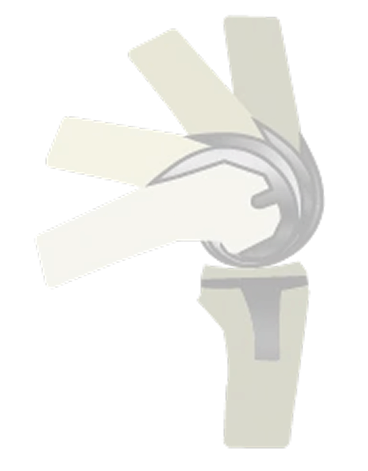

Knee arthritis can gradually make everyday activities such as walking, climbing stairs, standing, or getting up from a chair increasingly difficult. When pain and stiffness become severe and non-surgical treatments no longer provide enough relief, knee replacement surgery may be considered.
For patients who need knee replacement, one important question is whether they need a partial knee replacement or a total knee replacement.
The two procedures are designed for different patterns of knee damage. Partial knee replacement treats arthritis that is limited to one part of the knee, while total knee replacement replaces the damaged surfaces of more than one compartment of the knee.
Choosing between them is not simply a matter of deciding which procedure is "better." The appropriate option depends on the location and severity of arthritis, ligament condition, knee alignment, range of movement, age, activity level, and overall health.
Understanding the difference between partial and total knee replacement can help you have a more informed discussion with your orthopedic surgeon.
A partial knee replacement, also called unicompartmental knee replacement, replaces only the damaged compartment of the knee.
The knee has three main compartments: the medial compartment on the inner side, the lateral compartment on the outer side, and the patellofemoral compartment between the kneecap and thigh bone.
In some patients, arthritis is mainly limited to one compartment. If the remaining cartilage and other structures of the knee are relatively healthy, replacing only the damaged area may be an option.
The surgeon removes the damaged bone and cartilage from the affected compartment and places artificial components in that area while preserving the healthy portions of the knee.
A total knee replacement involves replacing the damaged surfaces of the main compartments of the knee with artificial components.
It is generally considered when arthritis has significantly affected multiple areas of the knee or when the damage is too extensive for a partial replacement.
During total knee replacement, the surgeon removes damaged cartilage and a small amount of bone from the femur and tibia and places artificial components to create a new bearing surface. The back of the kneecap may also be resurfaced depending on the patient's condition and surgical plan.
The objective is to reduce pain, improve alignment and stability, and restore useful knee function.
The simplest way to understand the difference is this:
Partial knee replacement treats arthritis that is limited to a specific part of the knee, while total knee replacement is used when damage is more widespread.
Partial replacement preserves more of the patient's natural knee structures. Total replacement replaces the damaged joint surfaces across the affected compartments.
The decision depends primarily on where the arthritis is located and how healthy the rest of the knee remains.
Partial knee replacement may be considered when arthritis is limited primarily to one compartment of the knee.
A patient may be considered for partial replacement when the remaining compartments have relatively healthy cartilage and the major stabilizing ligaments are functioning appropriately.
The knee should also have suitable alignment and movement for the procedure.
Partial knee replacement is therefore not simply determined by age. The condition of the knee is one of the most important factors.
A detailed clinical examination and appropriate imaging are necessary to determine whether the arthritis is sufficiently localized.
Total knee replacement may be recommended when arthritis affects multiple compartments or when there is extensive cartilage and bone damage.
It may also be considered when the knee has significant deformity, instability, stiffness, or other changes that make partial replacement unsuitable.
Patients with advanced osteoarthritis affecting much of the knee may therefore be better suited to total knee replacement.
The decision should be based on the overall condition of the knee rather than on symptoms alone.
One potential advantage of partial knee replacement is that it preserves more of the patient's natural knee.
Because less bone and tissue may need to be removed, the procedure can be less extensive than total knee replacement in appropriately selected patients.
Some patients may experience a more natural feeling knee because important parts of their original knee remain intact.
Recovery can also be quicker for some appropriately selected patients, although individual recovery varies.
Partial knee replacement may also involve less postoperative discomfort and a shorter hospital stay in some cases.
However, these potential advantages depend heavily on patient selection and surgical technique.
Total knee replacement is a well-established treatment for advanced knee arthritis.
It can address arthritis affecting multiple compartments of the knee and may be appropriate when there is significant deformity, stiffness, or widespread joint damage.
For patients with advanced arthritis, total replacement can provide substantial pain relief and improvement in walking and everyday function.
Because more of the damaged joint is replaced, total knee replacement can be a suitable option when disease is too extensive for a partial replacement.
Some patients experience less postoperative pain following partial knee replacement because the procedure may involve less disruption to the knee.
However, pain after surgery varies considerably between individuals.
Pain management, surgical technique, rehabilitation, overall health, and the extent of the original knee damage all influence recovery.
Partial knee replacement should not be selected solely because a patient expects it to be painless.
Partial knee replacement can allow a faster early recovery in appropriately selected patients.
Patients may regain mobility relatively quickly because more of the natural knee is preserved.
However, recovery is influenced by several factors, including age, muscle strength, overall health, preoperative mobility, and adherence to physiotherapy.
A patient undergoing total knee replacement can also make excellent progress when rehabilitation is appropriately managed.
One potential advantage of partial knee replacement is that it preserves more of the natural knee structures.
Because the unaffected parts of the knee remain in place, some patients report that the knee feels more natural during movement.
However, the sensation after surgery varies from person to person.
The final result depends on the patient's knee anatomy, implant positioning, ligament function, rehabilitation, and other factors.
Both partial and total knee replacements can provide long-term improvement, but their longevity can vary.
The lifespan of an implant depends on factors such as implant design, surgical technique, positioning, activity level, body weight, bone quality, and overall health.
Partial knee replacement may have a higher likelihood of requiring additional surgery in some patient groups because arthritis can later develop or progress in other parts of the knee.
This does not mean that partial knee replacement is a poor choice. For appropriately selected patients, it can be an effective long-term treatment.
Yes.
If a partial knee replacement develops a significant problem or arthritis progresses to other compartments of the knee, revision to a total knee replacement may sometimes be necessary.
The need for additional surgery varies between patients.
Careful patient selection for the initial partial knee replacement can help determine whether it is an appropriate option.
Both procedures are intended to improve walking ability and reduce pain.
After surgery, patients need time to recover muscle strength, knee movement, balance, and confidence.
Partial knee replacement may allow some patients to return to normal walking sooner, but there is no universal timeline.
Following a structured rehabilitation program is important regardless of which procedure is performed.
Your orthopedic surgeon will assess several factors before recommending partial or total knee replacement.
The location of cartilage damage is particularly important.
Your surgeon may also evaluate knee alignment, ligament stability, range of movement, bone condition, symptoms, activity level, and the condition of the other knee compartments.
X-rays and other imaging may help determine the extent and location of joint damage.
The final decision should combine the imaging findings with your physical examination and symptoms.
Age alone does not determine which type of knee replacement is appropriate.
A younger patient may be suitable for partial replacement if arthritis is limited to one compartment and the rest of the knee is healthy.
An older patient may also be a candidate for partial replacement if the knee meets the necessary criteria.
Similarly, a younger or older patient may require total knee replacement when arthritis is widespread.
The condition of the knee matters more than age alone.
When arthritis affects multiple compartments, partial knee replacement may not provide a complete solution.
Replacing only one damaged area would leave other arthritic surfaces untreated.
In such situations, total knee replacement may be considered because it addresses the more widespread joint damage.
This is one reason accurate imaging and careful examination are important before surgery.
Knee deformity can occur with advanced arthritis.
Significant bow-legged or knock-kneed alignment may influence whether partial replacement is appropriate.
Some patients with mild deformity may still be candidates for partial replacement, while more advanced deformity may make total replacement more suitable.
Your orthopedic surgeon will assess alignment and the condition of the ligaments and joint compartments before making a recommendation.
There is no single procedure that is right for every patient.
If arthritis is limited to one compartment and the rest of the knee is healthy, partial knee replacement may be an option.
If arthritis affects multiple compartments or there is significant deformity, instability, stiffness, or extensive joint damage, total knee replacement may be more appropriate.
The goal is to choose the procedure that addresses the actual problem in your knee while providing the best opportunity for pain relief and useful function.
Knee replacement is not simply about placing an implant.
Successful treatment requires accurate diagnosis, appropriate patient selection, careful surgical planning, precise implant positioning, soft-tissue balancing, and structured rehabilitation.
Modern technologies, including computer-assisted and robotic-assisted systems, may help surgeons with planning and precision in selected knee replacement procedures.
However, technology is a tool that supports surgical decision-making. It does not replace the surgeon's clinical judgment.
If you are considering knee replacement, ask your orthopedic surgeon whether your arthritis is limited to one compartment or affects multiple areas of the knee.
You can also ask whether your ligaments are healthy, whether your knee alignment is suitable for partial replacement, what type of implant is recommended, and what recovery you can realistically expect.
It is also useful to understand the potential benefits and limitations of each option before making a decision.
The choice between partial and total knee replacement depends largely on the extent and location of arthritis.
Partial knee replacement preserves more of the natural knee and may be appropriate when arthritis is confined to one compartment and the remaining structures are healthy.
Total knee replacement is generally considered when arthritis is more widespread or when significant deformity, instability, stiffness, or joint damage makes partial replacement unsuitable.
Neither procedure is automatically right for everyone. A detailed orthopedic assessment is necessary to determine which approach matches the condition of your knee.
If knee pain is affecting your ability to walk, climb stairs, sleep, work, or enjoy daily activities, consulting an experienced orthopedic specialist can help you understand your treatment options and whether knee replacement may be appropriate.
What is the difference between partial and total knee replacement?
Partial knee replacement replaces only the damaged compartment of the knee, while total knee replacement replaces the damaged joint surfaces across multiple compartments.
Is partial knee replacement better than total knee replacement?
The two procedures are designed for different patterns of knee damage. Partial replacement may be suitable when arthritis is limited to one compartment, while total replacement may be appropriate for more widespread arthritis.
Who is a candidate for partial knee replacement?
Patients with arthritis primarily limited to one compartment, suitable knee alignment, good ligament function, and relatively healthy remaining cartilage may be candidates for partial knee replacement.
Does partial knee replacement recover faster?
Some appropriately selected patients may experience faster early recovery after partial knee replacement. However, recovery varies depending on individual health, strength, rehabilitation, and other factors.
Can partial knee replacement become a total knee replacement later?
Yes. If arthritis progresses in other areas of the knee or the partial implant develops a significant problem, conversion to total knee replacement may sometimes be required.
Which knee replacement lasts longer?
Both partial and total knee replacements can provide long-term results. Implant longevity depends on several factors, including surgical technique, implant design, activity level, body weight, and overall health.
Can I walk normally after knee replacement?
Many patients can return to comfortable walking after completing rehabilitation. The timeline varies depending on the type of surgery and individual recovery.
Does age determine whether I need partial or total knee replacement?
No. Age is only one consideration. The location and severity of arthritis, ligament condition, alignment, range of movement, and overall health are important factors when choosing the procedure.