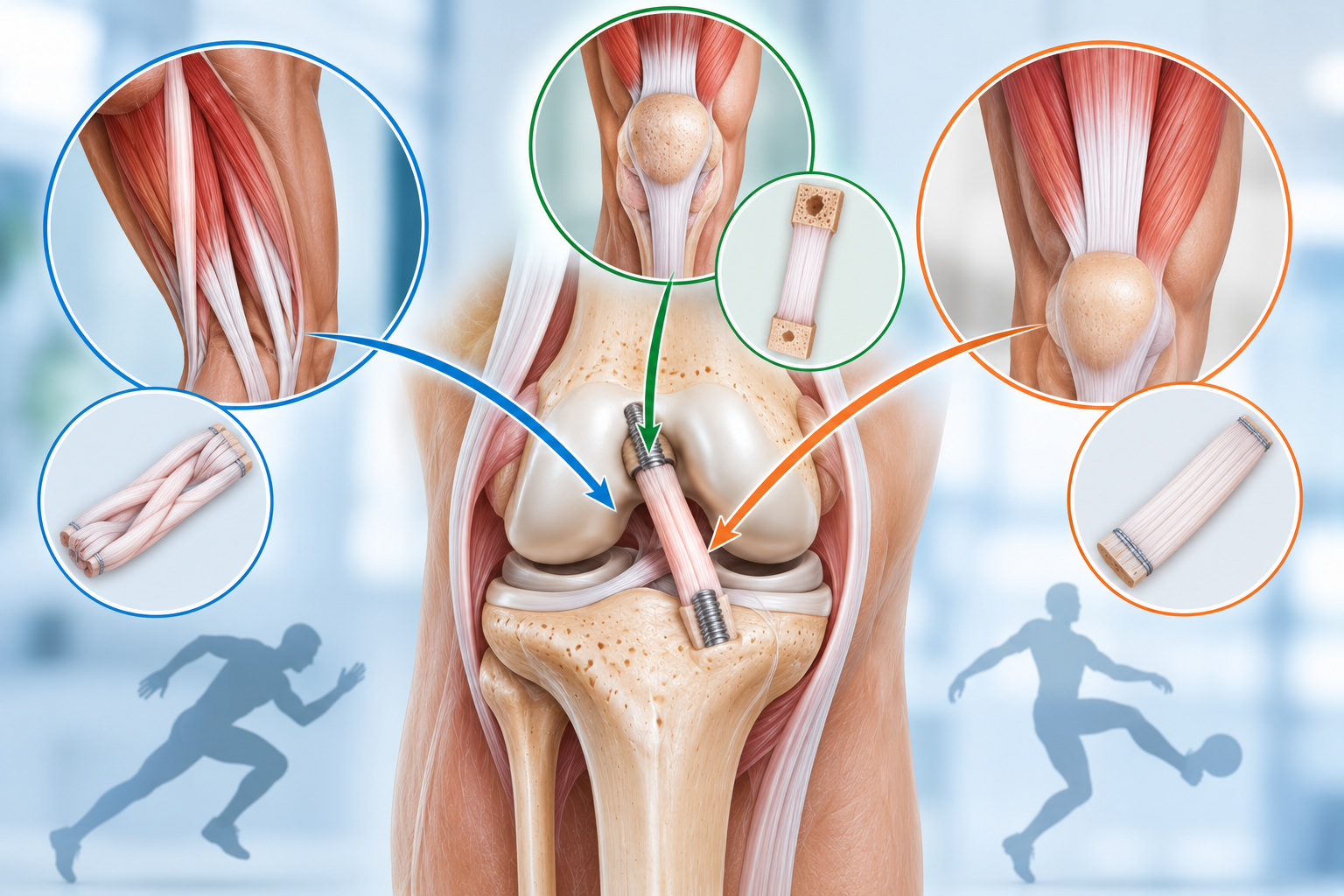
An anterior cruciate ligament (ACL) tear is one of the most common serious knee injuries, particularly among people who participate in sports involving running, jumping, sudden stops, or changes in direction. When ACL reconstruction is recommended, one of the most important decisions is choosing the right graft.
Patients are often asked to consider three commonly used graft options: the hamstring tendon, patellar tendon, and quadriceps tendon.
Each graft has advantages and potential disadvantages. There is no single graft that is automatically best for every patient. The choice depends on factors such as age, activity level, sport, knee anatomy, previous surgery, associated injuries, rehabilitation goals, and the surgeon's experience.
Research comparing these grafts generally shows that all three can provide good clinical outcomes. Recent evidence also suggests that quadriceps tendon grafts are a well-established alternative to hamstring and patellar tendon grafts, with broadly similar graft failure and functional outcomes in many studies.
Understanding how each graft is obtained and what it may mean for recovery can help patients have a more informed discussion with their orthopedic surgeon.
The ACL does not usually heal back to its original structure after a complete tear. When reconstruction is required, the damaged ligament is replaced with a new tissue graft.
The graft acts as a new ligament inside the knee. Over time, the graft undergoes biological changes and becomes incorporated into the knee.
A graft can come from the patient's own tissue, called an autograft, or from donor tissue, called an allograft.
For many active patients undergoing ACL reconstruction, autografts are commonly considered because of their established clinical use and generally favorable outcomes.
The three autografts discussed most often are the hamstring tendon, bone-patellar tendon-bone graft, and quadriceps tendon graft.
The graft is an important part of ACL reconstruction, but it is not the only factor that determines the outcome.
Surgical technique, correct tunnel placement, rehabilitation, muscle strength, return-to-sport timing, and the patient's adherence to postoperative instructions all influence recovery.
Graft selection matters because harvesting tissue from different parts of the leg can affect strength, pain, and function in different ways.
For example, a patellar tendon graft may provide a strong bone-to-bone construct but can be associated with pain around the front of the knee. A hamstring graft avoids harvesting from the patellar tendon but can temporarily affect hamstring strength. A quadriceps tendon graft provides a large tendon graft and may have lower donor-site morbidity in some studies, although quadriceps strength recovery deserves particular attention during rehabilitation.
The hamstring graft is commonly obtained from one or more of the hamstring tendons, usually the semitendinosus and sometimes the gracilis.
The harvested tendon is prepared into a suitable graft and placed in the knee to reconstruct the ACL.
Hamstring autografts have been used extensively for ACL reconstruction and have a large body of clinical evidence supporting their use.
One potential advantage is that harvesting the graft does not involve the patellar tendon.
This may be relevant for patients who are concerned about pain when kneeling.
Hamstring grafts can also provide good clinical stability and functional outcomes. Recent randomized-trial evidence comparing hamstring and quadriceps tendon autografts found no significant differences in patient-reported outcomes, graft failure, or overall adverse events at two years.
Because tissue is harvested from the hamstring region, some patients can experience temporary weakness in hamstring strength.
This is particularly relevant for athletes whose sports require powerful sprinting, acceleration, or repeated knee flexion.
Rehabilitation can address these strength deficits through progressive hamstring and lower-limb strengthening.
The individual patient's sport, strength profile, and rehabilitation goals should therefore be considered when choosing this graft.
The bone-patellar tendon-bone (BPTB) graft is taken from the central portion of the patellar tendon, along with small bone plugs from the kneecap and shin bone.
The bone plugs allow the graft to be fixed within the bone tunnels created during ACL reconstruction.
The patellar tendon has been one of the most established graft choices for ACL reconstruction, particularly among athletes and patients involved in high-demand pivoting sports.
One of the important characteristics of a BPTB graft is the use of bone plugs at both ends.
This allows bone-to-bone healing within the tunnels.
BPTB grafts have a long history of use in ACL reconstruction, and research has demonstrated good stability and functional outcomes.
For some athletes, particularly those participating in high-demand sports, the graft may be an attractive option when the surgeon considers its characteristics appropriate.
The main concern for some patients is pain at the front of the knee.
Patients may experience discomfort when kneeling or performing activities that place pressure on the front of the knee.
The graft harvest site can also contribute to postoperative discomfort.
Research comparing quadriceps and patellar tendon grafts has found lower donor-site morbidity with quadriceps tendon grafts in several analyses.
However, individual outcomes vary, and a patellar tendon graft remains an established option for ACL reconstruction.
The quadriceps tendon is a strong tendon located above the kneecap and connects the quadriceps muscles to the patella.
A portion of the quadriceps tendon can be harvested and used as an ACL graft. Depending on the surgical technique, the graft may include a small bone plug or consist entirely of soft tissue.
Quadriceps tendon grafts have become increasingly popular as an alternative to traditional hamstring and patellar tendon grafts.
The quadriceps tendon provides a relatively large graft with substantial tissue volume.
It may be particularly useful when the surgeon wants a robust autograft while avoiding some of the donor-site concerns associated with harvesting the central patellar tendon.
Recent systematic reviews and randomized-trial evidence suggest that quadriceps tendon grafts can provide similar graft failure rates, knee stability, and patient-reported outcomes compared with hamstring and patellar tendon grafts. Some studies have also reported lower donor-site morbidity with quadriceps tendon grafts.
Because the graft is harvested from the quadriceps tendon, temporary weakness of the quadriceps muscle can occur.
This means rehabilitation needs to place particular attention on restoring quadriceps strength and function.
Recent research comparing graft-specific strength recovery suggests that quadriceps tendon graft patients may demonstrate greater quadriceps extension deficits than hamstring graft patients during some stages of recovery, reinforcing the importance of individualized rehabilitation.
This does not mean quadriceps grafts are unsuitable. Instead, it highlights why rehabilitation should be tailored to the graft used.
Both grafts have been used successfully for ACL reconstruction for many years.
A patellar tendon graft has the advantage of bone-to-bone healing and a long history of use in ACL surgery. However, anterior knee pain and kneeling discomfort can be concerns.
Hamstring grafts avoid harvesting the patellar tendon and may therefore be attractive for patients who frequently kneel or have concerns about anterior knee symptoms. However, hamstring strength may be temporarily affected following graft harvesting.
The choice should be based on the patient's individual requirements rather than assuming one graft is universally better.
Both hamstring and quadriceps tendon grafts are soft-tissue autograft options.
Recent randomized evidence has found broadly similar patient-reported outcomes, graft failure rates, and overall complications between the two.
The potential difference may become more relevant when considering donor-site symptoms and muscle strength.
Hamstring harvesting can affect hamstring strength, while quadriceps tendon harvesting can temporarily affect quadriceps strength.
The importance of each depends on the patient's sport, occupation, baseline strength, and rehabilitation goals.
Both can provide strong and effective grafts for ACL reconstruction.
The patellar tendon graft has extensive clinical experience behind it and provides bone plugs for bone-to-bone healing.
The quadriceps tendon provides a substantial tendon graft and may be associated with less donor-site morbidity than BPTB grafts in several studies.
However, quadriceps strength recovery may require particular attention after surgery.
There is no universal answer regarding which option is best. The patient's anatomy, sport, previous injuries, and rehabilitation goals should all be considered.
This is a common concern among athletes.
Research has produced different findings depending on study design, patient population, graft preparation, follow-up duration, and other factors.
A recent systematic review of randomized controlled trials comparing quadriceps, hamstring, and patellar tendon autografts found similar graft failure rates across the three graft types.
This is important because it means graft selection should not be based solely on the assumption that one graft is guaranteed to prevent reinjury.
The patient's age, sport, surgical technique, rehabilitation, and return-to-sport timing also matter.
There is no single graft that is best for every athlete.
An athlete who participates in football, cricket, basketball, badminton, tennis, or other pivoting sports may have different requirements from someone who primarily walks, cycles, or performs recreational exercise.
The surgeon may consider the patient's sport, age, muscle strength, previous injuries, contralateral knee condition, and expectations.
The goal is to select a graft that provides appropriate stability while minimizing problems at the graft harvest site.
Graft choice can influence certain aspects of rehabilitation, particularly the muscle group from which the graft is harvested.
With a hamstring graft, rehabilitation may include additional attention to hamstring strength.
With a patellar tendon graft, the rehabilitation program may need to address anterior knee symptoms and quadriceps function.
With a quadriceps tendon graft, restoring quadriceps strength can be particularly important.
However, the overall ACL reconstruction recovery timeline depends on many factors and should not be determined by graft choice alone.
Returning to running, jumping, cutting, and competitive sport should depend on rehabilitation milestones and functional testing rather than simply the number of months since surgery.
The graft is selected after considering the entire patient rather than one isolated factor.
Your orthopedic surgeon may consider your age, activity level, sport, occupation, knee anatomy, ligament condition, previous surgeries, associated meniscus or cartilage injuries, muscle strength, and expectations.
For example, a patient who frequently kneels for work may have different priorities from an athlete who needs to return to a pivoting sport.
Someone with previous surgery involving the hamstrings or patellar tendon may also have fewer suitable graft options.
Allografts use tissue obtained from a donor rather than from the patient's own body.
They may be considered in selected situations, but graft choice depends heavily on patient age, activity level, surgical circumstances, and surgeon preference.
For younger or highly active patients, autografts are commonly considered because of concerns about graft failure associated with some allograft use.
Your surgeon can explain whether an allograft has a role in your specific situation.
The graft choice is generally planned before surgery based on clinical assessment and imaging.
However, surgical findings and the condition of the available tissue can sometimes influence the final decision.
Patients should discuss graft options with their surgeon before the operation and understand why a particular graft has been recommended.
Choosing an appropriate graft is only one part of ACL reconstruction.
The reconstructed ligament needs time to heal and mature. During rehabilitation, the patient progressively restores knee movement, strength, balance, coordination, and sport-specific function.
Early rehabilitation focuses on reducing swelling, restoring knee extension, improving movement, and activating the quadriceps.
Later stages focus on progressive strengthening, running, jumping, landing mechanics, agility, and sport-specific movements.
Returning to sport before adequate strength and movement control have returned can increase the risk of reinjury.
For a patient undergoing ACL reconstruction, graft selection should be based on the individual's knee condition, activity requirements, sport, and recovery goals.
Dr. Praveen Reddy's orthopedic and sports-injury practice focuses on evaluating the patient's injury and developing a treatment plan appropriate to the specific knee problem.
A detailed assessment can help determine whether ACL reconstruction is required and, if so, which graft option may be appropriate.
The goal is not simply to reconstruct the ligament but to restore knee stability and help the patient return safely to everyday activities, work, and sports.
Choosing an ACL graft is an important part of reconstruction, but there is no single graft that is automatically best for every patient.
Hamstring, patellar tendon, and quadriceps tendon autografts are all established options, and current research suggests that they can provide good stability and functional outcomes when appropriately selected.
The differences often come down to donor-site considerations and the type of strength recovery required during rehabilitation.
Hamstring grafts may affect hamstring strength, patellar tendon grafts can be associated with anterior knee or kneeling discomfort, and quadriceps tendon grafts may require particular attention to quadriceps strength during recovery.
The best choice depends on your knee, your sport, your activity level, previous injuries, and your surgeon's assessment.
If you have an ACL tear and are considering reconstruction, discussing all available graft options with an experienced orthopedic and sports-injury specialist can help you understand the potential benefits and limitations of each approach before surgery.
Which graft is best for ACL reconstruction?
There is no single graft that is best for every patient. Hamstring, patellar tendon, and quadriceps tendon autografts can all provide good outcomes. The appropriate choice depends on the patient's age, sport, anatomy, previous injuries, activity level, and rehabilitation goals.
Is a hamstring graft better than a patellar tendon graft?
Both are established ACL graft options. Hamstring grafts avoid harvesting the patellar tendon, while patellar tendon grafts provide bone plugs and have a long history of use. The choice should be individualized.
Is a quadriceps tendon graft a good option for ACL reconstruction?
Yes. Quadriceps tendon autografts are an established option and recent evidence suggests comparable graft failure and functional outcomes to hamstring and patellar tendon grafts in many patients.
Which ACL graft has the lowest risk of failure?
Current evidence does not establish one of these three autografts as universally superior for preventing failure. Graft choice, surgical technique, rehabilitation, patient factors, and return-to-sport timing all contribute to the risk of reinjury.
Does a patellar tendon graft cause knee pain?
Some patients experience anterior knee pain or discomfort while kneeling after a patellar tendon graft. The degree of symptoms varies between individuals.
Does a hamstring graft make the hamstring weak?
Hamstring strength can be reduced after tendon harvesting, particularly during the early stages of recovery. Progressive rehabilitation is used to restore strength and function.
Does a quadriceps tendon graft weaken the thigh?
Quadriceps strength can be reduced temporarily after harvesting the graft. Rehabilitation places particular emphasis on restoring quadriceps strength and control.
How long does it take to return to sports after ACL reconstruction?
Return to sport varies between patients. High-demand pivoting sports commonly require many months of rehabilitation, and return should be based on strength, movement quality, functional testing, and psychological readiness rather than time alone.